Yes, non-swimmers can snorkel safely, but only when three things are locked in: a proper flotation device, calm and shallow water, and a guide staying within arm’s reach the whole time. If panic hits, the fix is always the same: stop, lift the snorkel out of the water, breathe slowly, then roll onto your back or stand up and signal your guide. Some operators build entire trips around this exact setup, pairing flotation gear with in-water guides so non-swimmers aren’t figuring it out alone.
TL;DR:
- Non-swimmers should choose guided trips with guides in the water, flotation gear included, and a focus on calm, shallow, protected waters.
- Flotation devices like belts or vests that support face-down positioning are more effective and practical than bulky life jackets.
- Preparing through short, shallow-water practice sessions enhances comfort, especially practicing gear clearing and recovery techniques beforehand.
- Asking operators about non-swimmer support, group size, gear included, and guide proximity helps ensure a safe snorkeling experience.
- Staying aware of signs of distress and having a clear emergency plan, including signals and breathing control, are crucial for safety during snorkeling.
Table of Contents
- Which snorkeling setups work best if you can’t swim?
- What flotation gear actually keeps you safe?
- How do you pick a safe spot to snorkel?
- What drills help you get comfortable before you go?
- What should you ask before booking a guide?
- What do you do if something goes wrong in the water?
- How does Lembongan Water Sport support non-swimmers?
- How do you get past the fear of putting your face in the water?
- What basic water safety skills should every non-swimmer learn first?
- Why does a buddy or guide matter more than gear?
- How should non-swimmers adjust their snorkeling technique?
- What are the warning signs of distress, and how do you signal for help?
- The gap between snorkel marketing and what non-swimmers actually need
- Ready to book a guided snorkel trip that fits non-swimmers?
- Sources
- FAQ
Which snorkeling setups work best if you can’t swim?
Not every snorkel trip is built for someone who’s never learned to swim. The setup matters more than the destination, and three formats stand out for very different reasons.
Guided small-group tours are usually the safest bet. A guide stays in the water with you, flotation is handed out before anyone gets wet, and the pace stays slow enough that nobody feels rushed into deep water. Operators who provide flotation and in-water assistance tend to report calmer, safer first experiences for nervous guests, and the small-group format means a guide actually notices if you’re struggling.
Shore and edge snorkeling solves a different problem: the fear of not being able to touch bottom. Staying within a few feet of a beach, reef shelf, or dock ladder means you can stand up the second something feels wrong. This is often the best starting point before anyone gets on a boat.
Boat trips can still work for non-swimmers, but only with safeguards. Before boarding, confirm:
- Flotation belts or vests are provided on board, not just available for rent
- A guide gets in the water with you, not just watches from the boat
- The boat anchors in a sheltered spot, not open current
- Group size stays small enough that one guide can watch everyone
Skip any boat operation that hands you a mask and points at the water.
What flotation gear actually keeps you safe?
Flotation is not one-size-fits-all, and picking the wrong piece of gear can make face-down snorkeling harder instead of easier.
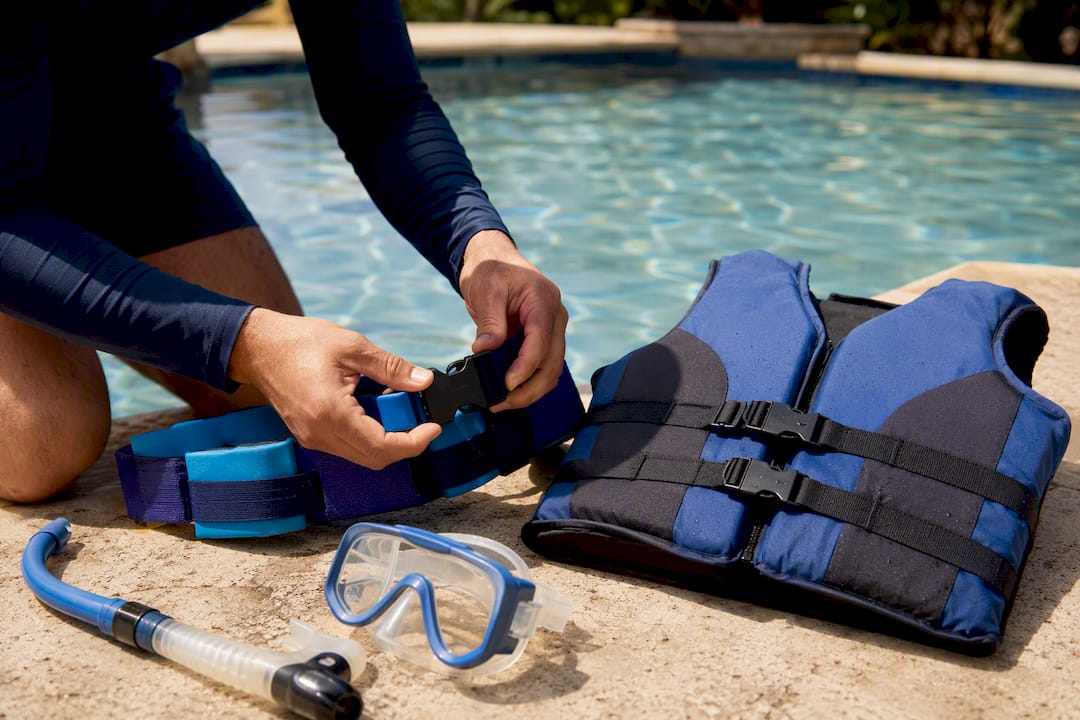
A snorkel belt wraps around your waist and is built specifically to hold you in a horizontal, face-down position, which is exactly the posture you need to actually see anything underwater. A snorkel vest does something similar but supports your chest and upper body, which some people find more reassuring because it feels closer to a life jacket. A standard life jacket, by contrast, is designed to keep your head and shoulders upright out of the water, the opposite of the position you want for snorkeling. Snorkel belts and vests are generally more practical for face-down viewing than a bulky life jacket, which tends to fight your body position instead of supporting it. A swim buoy trailed behind you on a leash adds visible surface flotation and gives you something to grab and rest on mid-swim.
Fit matters as much as the device itself:
- The belt or vest should sit snug but not restrict your breathing
- Your mask should seal against your face with no hair or straps crossing the seal
- Fins should fit close without pinching. Shorter, softer blades reduce the leg effort a nervous swimmer needs
Pro Tip: If you’re tempted by a full-face mask because it feels less claustrophobic, ask your guide to walk you through removing it in shallow water first. Full-face designs can trap exhaled air and build up carbon dioxide if not cleared properly, and a beginner who’s never practiced the removal motion can panic if water gets in.
How do you pick a safe spot to snorkel?
Location decides more of your safety margin than any piece of gear. Before you get in, run through this checklist.
Look for:
- A flat, calm surface with little to no wind chop
- No visible current pulling along the shoreline
- Clear visibility, so you can see the bottom and any hazards
- Minimal boat traffic in the immediate area
Favor these settings:
- Protected coves and reef-sheltered lagoons where waves break well offshore
- Lifeguarded beaches with posted conditions
- Shore-entry sites over deep-water boat drops for your first attempts
Protected lagoons and reef-sheltered coves are consistently recommended over exposed sites for anyone still building water confidence, and destinations like Nusa Lembongan get singled out repeatedly for calmer conditions and shorter boat rides than more exposed nearby islands.
Call it off if you see: breaking surf, visible current lines, murky water, or a crowded boat channel. No view is worth entering water you can’t read.
What drills help you get comfortable before you go?
Confidence in the water comes from repetition, not bravery. A short, structured warm-up beats a single long practice session, and you can do most of it before your trip even starts.
- Start dry. Put the mask on at home or in a hotel room and practice breathing through the snorkel while sitting upright. Get used to the sound and feel of your own breath through the tube.
- Move to shallow water. Standing where the water hits your chest, put your face in and practice slow, steady breaths through the snorkel for 30 seconds at a time.
- Progress to edge snorkeling. Put on your belt or vest, float at the surface, take three calm breaths, then look down. Add a few gentle kicks once you’re relaxed.
- Practice clearing your gear. Learn the sharp exhale that clears water from a flooded snorkel, and practice breaking your mask seal to let water in and out on purpose, so it never surprises you.
- Rehearse your recovery. Practice rolling onto your back or standing up from a face-down float, and practice waving one arm overhead as a signal.
Short, spaced practice sessions in shallow water reduce anxiety far more effectively than trying to power through nerves on trip day. Three brief sessions over two days beat one marathon attempt the night before.
Pro Tip: Practice clearing your snorkel and mask on purpose, in water where you can stand. A cleared airway that surprised you once in deep water is a lot scarier than one you triggered yourself in a pool.
What should you ask before booking a guide?
The right questions weed out operators who aren’t set up for non-swimmers before you’re standing on a dock wondering if you made a mistake.
Ask directly:
- Do you accept guests who can’t swim, and how do you support them?
- Is flotation gear included, or is it a rental add-on?
- What’s your guide-to-guest ratio in the water?
- Will a guide be physically in the water near me, or watching from a boat?
Red flags that mean you should look elsewhere: no guide gets in the water, flotation isn’t offered upfront, or the group is too large for one guide to track everyone.
Trust signals worth prioritizing: guides with lifeguard or first-aid training, small group sizes, a safety briefing before anyone enters the water, and clear hand signals explained in advance. A slow, coached entry with a guide staying close matters more than any single piece of gear, so ask specifically how the entry itself is handled, not just what equipment you’ll get.
What do you do if something goes wrong in the water?
Panic is the actual danger for non-swimmers, not the water itself. Non-swimming status is a known risk factor for drowning incidents, and shortness of breath combined with panic is what escalates a manageable moment into an emergency. The fix is a short, memorized sequence, not a complicated rescue plan.
- Stop moving. Fighting the water burns air and energy you need.
- Remove or lift your snorkel so you can breathe normally through your mouth.
- Breathe slowly, in through the nose if possible, to slow your heart rate.
- Roll onto your back if you’re floating, or stand up if you’re in shallow water.
- Wave one arm overhead or blow a whistle to signal your guide.
A guide who’s doing their job responds immediately: closing the distance, offering a tow or an arm to the ladder or shore, and having basic first aid ready if needed. Before you get in the water, pack a signaling whistle, reef-safe sunscreen, and footwear that protects against sharp coral or rocks on entry and exit.
How does Lembongan Water Sport support non-swimmers?
Guided snorkeling trips often pair flotation gear with in-water support built around recommended safeguards: belts or vests handed out before anyone enters the water, small groups, and guides who stay close rather than watching from a boat. Trips run in the sheltered waters around Nusa Lembongan and Nusa Penida, the kind of calmer, protected setting recommended for beginners rather than exposed open water. Positive customer feedback often points to personalized attention non-swimmers receive, including pre-water briefings and guides who match pace to the guest’s comfort level rather than the group average.
How do you get past the fear of putting your face in the water?
Fear of water rarely responds to logic, so trying to reason yourself calm usually doesn’t work. What does work is breaking the experience into pieces small enough that none of them feel threatening.
Start by separating the fear of drowning from the fear of the unknown. Most non-swimmers aren’t actually afraid of floating. They’re afraid of what happens if something goes wrong and no one notices. That’s why flotation and a close guide matter more psychologically than they might seem to on paper: they remove the “what if nobody sees me” scenario entirely.
Breathing control does more heavy lifting here than confidence pep talks. Slow, deliberate breathing through a snorkel, practiced on dry land first, gives your nervous system something concrete to focus on instead of spiraling. Anxiety tends to build when your brain has nothing to do but worry. Give it a job (counting breaths, watching your bubbles) and the fear has less room to grow.
Set a real exit point before you start. Tell your guide, out loud, “if I panic, I’m putting my feet down and stopping.” Saying it ahead of time makes it a plan instead of a failure. Most people who try snorkeling for the first time report the anxious part lasts less than the first two minutes in the water. Knowing that in advance can make those two minutes easier to sit through.
What basic water safety skills should every non-swimmer learn first?
You don’t need to know how to swim to snorkel, but a handful of basic water skills dramatically lower your risk, and you can learn them in a pool over an afternoon.
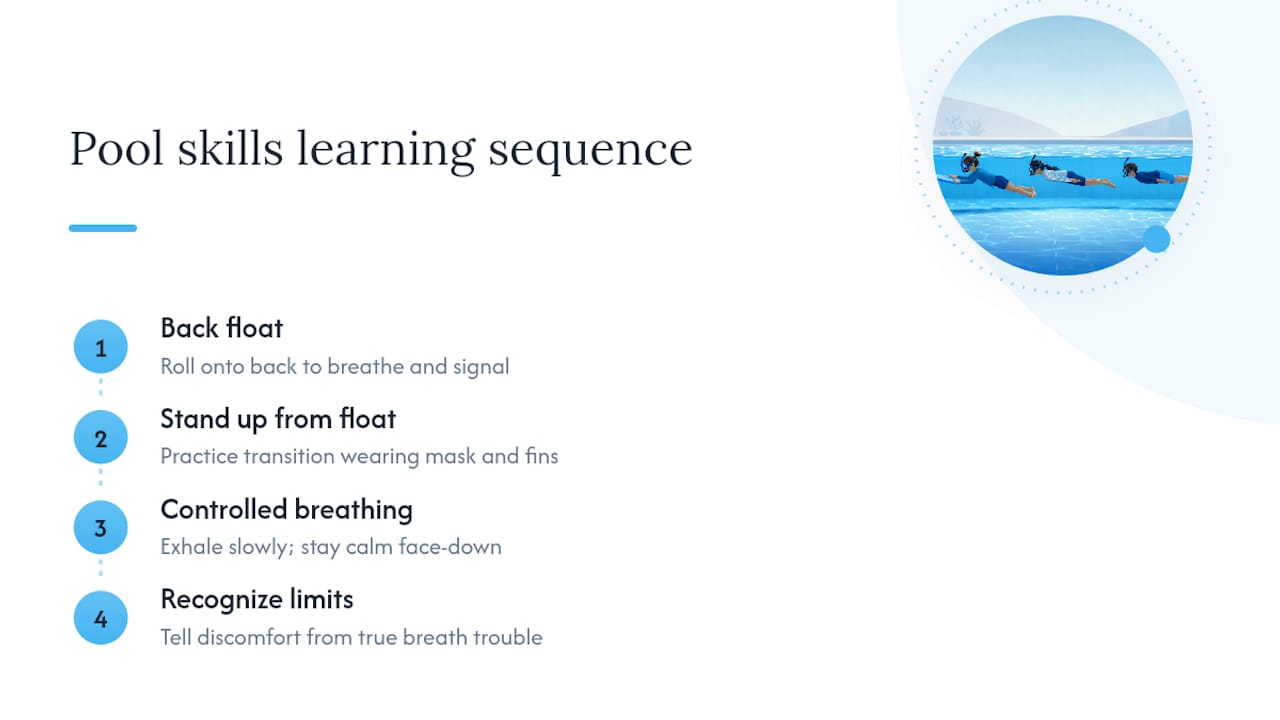
Floating on your back is the single most useful skill a non-swimmer can have. If anything goes wrong, rolling onto your back and floating buys you time to breathe and signal for help without needing to swim anywhere.
Standing up from a horizontal position sounds obvious until you’ve never practiced it wearing a mask and fins. Fins especially change your balance, so practicing the transition from floating to standing in a pool removes one more surprise from the actual trip.
Basic breath control matters beyond just snorkel use. Knowing how to exhale slowly and stay calm with your face in the water reduces the swallow-and-panic reflex that catches a lot of first-timers off guard.
Recognizing your own limits is a skill too. Knowing the difference between “this feels new and slightly uncomfortable” and “I actually can’t catch my breath” lets you self-correct before a guide has to intervene. None of this replaces swimming lessons, but a short pre-trip session focused on these specific skills changes how the actual snorkel trip feels.
Why does a buddy or guide matter more than gear?
Flotation keeps you afloat. A buddy or guide is what actually catches problems before they become emergencies, and the two aren’t interchangeable.
Gear fails silently. A slightly loose belt, a mask that fogs, a fin that slips off, none of these announce themselves loudly, and a non-swimmer alone in the water may not process a small equipment issue calmly enough to fix it. Small equipment failures are manageable with practice, but unfamiliarity is what triggers panic. A guide swimming next to you catches the fogged mask or the slipping fin before it becomes a bigger problem, because they’re watching for it and you’re not.
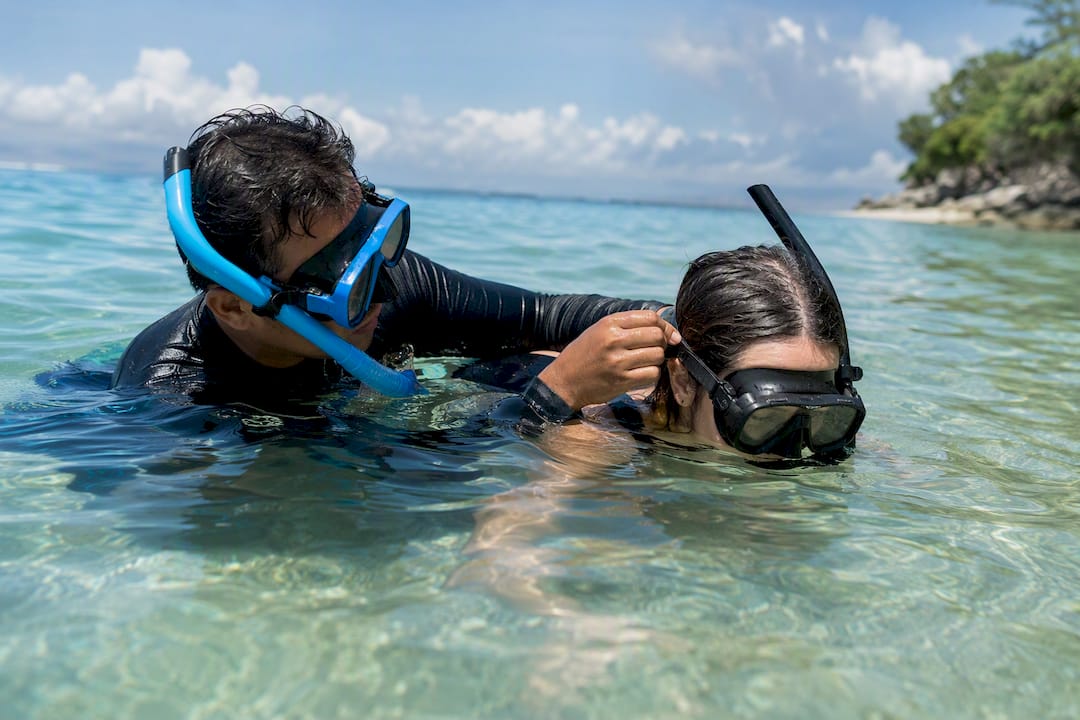
A guide also changes your decision-making in the moment. Alone, a non-swimmer who starts to feel anxious has to talk themselves down. With a guide present, that job is shared. A hand signal, a nod, a guide moving closer, these small interactions interrupt a building panic response far faster than internal self-talk does.
This is also why solo snorkeling, even in calm water, isn’t a good idea for anyone who can’t swim. It’s not about assuming the worst will happen. It’s that the entire safety model for non-swimmer snorkeling depends on someone else being able to respond faster than a bad moment can escalate. Remove that person, and the flotation gear is doing a job it was never designed to do alone.
How should non-swimmers adjust their snorkeling technique?
Snorkeling technique for a confident swimmer and technique for a non-swimmer aren’t the same skill wearing different labels. The adjustments matter.
Kick less, float more. A non-swimmer relying on flotation doesn’t need to generate forward motion the way a swimmer does. Small, slow fin movements are enough. Aggressive kicking burns energy fast and tends to come from anxiety rather than actual need.
Keep your head down longer than feels natural. New snorkelers often lift their head to check their surroundings, which breaks the mask seal and lets water in. Trust your peripheral vision and your guide instead of popping your head up every few seconds.
Breathe on a rhythm, not a reaction. Anxious breathing tends to speed up and shorten. Counting a slow four-count in, four-count out through the snorkel keeps your breathing steady even when your instincts want to speed up.
Stay horizontal, not vertical. The instinct to try to “stand” in deep water works against flotation gear that’s designed to hold you face down. Fighting your gear’s natural position wastes energy and increases panic risk.
Let the guide set your pace, not the group. A tour moving at the average group’s speed isn’t calibrated to you. A good guide adjusts; if yours doesn’t, say so before you’re already anxious in the water.
What are the warning signs of distress, and how do you signal for help?
Distress underwater rarely looks like a movie drowning scene. It’s quieter, and it’s easy to miss if you don’t know what to watch for.
Signs in yourself: rapid, shallow breathing through the snorkel; a tightening feeling in your chest; sudden urge to rip off your mask; or a sense that you can’t get enough air even though you’re breathing. Any one of these is your signal to stop immediately, not push through.
Signs in someone else: a snorkeler who’s stopped moving forward, whose head position looks tense or rigid, who’s grabbing at their mask or snorkel repeatedly, or who’s gone quiet after being vocal earlier. Distress often looks like stillness, not thrashing.
Communication underwater is limited to what you can see, so agree on signals before you get in:
- A raised, waving arm overhead means “I need help now”
- A hand flat, pushed down, means “I’m okay, slow down”
- Pointing to your own mask or snorkel means “something’s wrong with my gear”
- A thumbs-up, agreed in advance, means “ready to head back”
Confirm these with your guide during the pre-water briefing, not after you’re already floating. A signal nobody explained beforehand is a signal nobody will understand when it counts.
The gap between snorkel marketing and what non-swimmers actually need
Most snorkel content treats non-swimmers as an afterthought, a quick disclaimer bolted onto guides written for people who already know how to swim. That’s backward. The gear list matters less than the sequence: calm water first, flotation and guide proximity second, technique a distant third. A perfect snorkel belt in choppy, current-pulled water is still a bad plan.
The overrated piece of advice floating around is “just relax and trust the equipment.” Equipment doesn’t relax you. Practice does, and so does a guide who’s demonstrably paying attention rather than reciting a safety script before pointing at the water. If there’s one thing worth prioritizing above all else, it’s choosing who’s in the water with you before you choose where you’re going. A calm site with an inattentive guide is riskier than a slightly busier site with someone actually watching you.
Non-swimmers don’t need to be talked into snorkeling. They need a plan that respects what they don’t yet know how to do, and that plan starts with flotation, ends with a memorized emergency sequence, and has a real person in between the two.
— ada
Ready to book a guided snorkel trip that fits non-swimmers?
Most non-swimmers weighing snorkeling are choosing between skipping it entirely or trying a generic tour that wasn’t built with them in mind. Lembongan Water Sport is built around the middle option: guided snorkeling in the sheltered waters off Nusa Lembongan, with flotation gear included and guides who get in the water with you rather than watching from the boat.
Before you book, ask what this guide covers: confirm non-swimmer support is standard practice, check the group size for your date, and ask exactly what gear is included so you’re not scrambling to rent a belt or vest last minute. The family-friendly snorkeling trips are worth asking about specifically if you’re booking for kids or a nervous first-timer, since the pacing tends to be slower by design.
If you’re ready to see the reef instead of just reading about it, check current snorkeling trip options and message the team directly with your specific concerns. A quick WhatsApp conversation before you book tells you more about how an operator handles non-swimmers than any tour description will.
Sources
- Snorkeling for Beginners in Maui: Non-Swimmers Guide & Best Beaches
- Snorkeling for non-swimmers – How to do it in a safe way
- Is Snorkeling Safe For Non Swimmers: Is Snorkeling Safe For | Kona Snorkel Trips
- Best snorkelling spots in Bali
FAQ
Can I go snorkeling if I can’t swim?
Yes. Non-swimmers can snorkel safely with a snorkel belt or vest for flotation, a calm and shallow site, and a guide staying close in the water. Operators like Lembongan Water Sport build guided trips specifically around these three requirements.
Is snorkeling safe for non-swimmers?
It’s safe when the setup matches your skill level: proper flotation, protected water with no current, and in-water guide support rather than a guide watching from a boat. Guides who pace entries and stay physically close reduce the chance of a panic response far more than gear alone.
Can I snorkel if I can’t swim well in open water like Hawaii?
Yes, provided you pick a site known for calm, protected conditions rather than open exposed coastline, and book with an operator who explicitly welcomes non-swimmers. Non-swimmer specific guides recommend confirming flotation and guide support before booking any Hawaii snorkel trip, since not every operator is set up the same way.
Is snorkeling hard for beginners?
The physical skill itself is simple, mostly breathing through a tube while floating. What makes it feel hard is usually anxiety, not the technique, which is why short shallow-water practice sessions before the actual trip make such a difference.
What flotation device is best for a non-swimmer snorkeling?
A snorkel belt or vest works better than a standard life jacket because it holds you face down instead of upright, which is the position you need to actually see underwater. Belts and vests are generally more practical for snorkeling posture than bulkier flotation designed for a different purpose.